







Digital maturity check for mid-sized manufacturers: what to know before you invest
Most manufacturing SMBs invest in ERP, MES, or AI before understanding their baseline. A structured digital maturity check prevents costly mistakes — here's how it works.
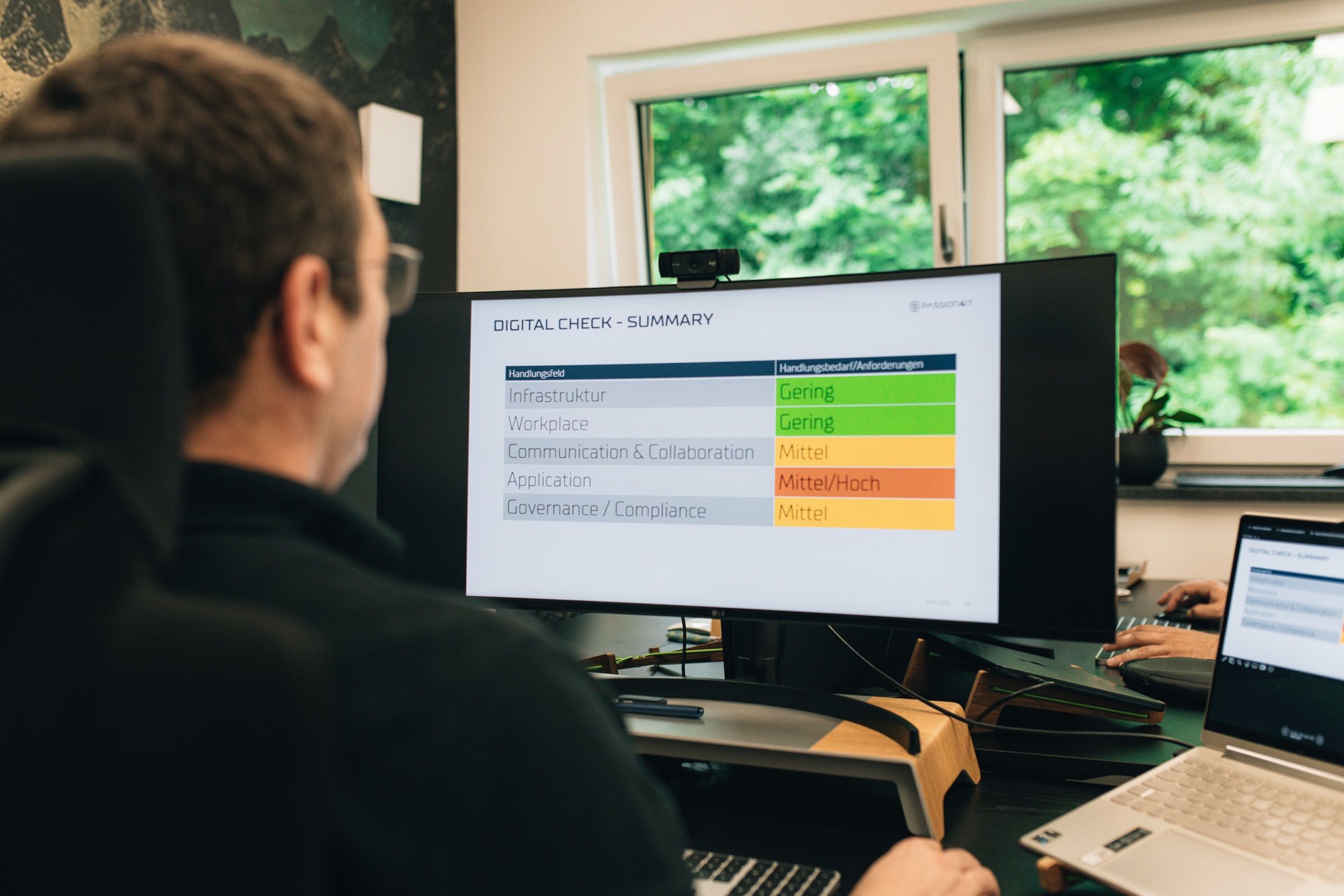
Most manufacturing companies with 50 to 600 employees don’t fail at digital transformation because they chose the wrong software. They fail because they invested before they understood where they actually stood. A digital maturity check gives you that honest baseline — before you spend a single euro on ERP upgrades, MES implementations, M365 rollouts, or AI pilots.
This article is written for managing directors, operations leads, and IT decision-makers in manufacturing SMBs who are either planning a significant digital investment or frustrated that previous projects haven’t delivered what was promised. The answer is usually not a better tool. It’s a clearer picture of your starting point.
The short version: the PASSION4IT Digital Check delivers an honest, structured assessment in 2–4 weeks at a fixed price of €3,950. You get a maturity assessment across five dimensions, a prioritized 12–24-month roadmap, and a concrete quick-win catalogue — not a slide deck built to justify more consulting.
Why manufacturing SMBs consistently underestimate their digital gap
The global data is consistent: most mid-sized manufacturers believe they are further along than they are. According to Eurostat’s 2024 digitalization report, only 73% of EU SMEs have reached even a basic level of digital intensity — meaning they use at least 4 of 12 common digital technologies. The EU’s own 2030 target is 90%, leaving a gap that is wider than most executives expect (Eurostat Digitalisation in Europe 2025).
The picture is similar elsewhere. In the UK, Make UK’s 2025 “Making it Smarter” survey found that only 10% of UK manufacturers are fully digitalized — with AI, IoT, and automation deeply integrated. 69% are partially digitalized, meaning some tools are in use but significant gaps remain. Just 4% have not yet started (Make UK / Make Smart, 2025).
In the United States, industry surveys indicate that only 26% of middle-market manufacturers have developed an Industry 4.0 strategy, with another 28% in the process of developing one — leaving nearly half with no coherent digital roadmap at all.
The pattern across markets is the same: manufacturers have more partial adoption, more isolated tools, and more undocumented processes than their self-assessments suggest.
What digital maturity actually measures
Digital maturity is not about whether you have software. It is about whether that software changes how your organization actually works — in production planning, quality control, data processing, machine connectivity, team collaboration, and strategic decision-making.
A proper maturity assessment covers five dimensions:
1. Organization and leadership. Who owns digitalization in your company? Are decisions data-driven or gut-driven? Is there a budget? Are middle managers involved or bypassed? In manufacturing especially, this layer determines whether any digital initiative survives contact with the shop floor.
2. Strategy and business model. Do you have defined digital goals? Are they connected to business outcomes — throughput, reject rates, lead times — or are they technology-first (“we need AI”)? Without measurable targets, no project can be evaluated.
3. Processes and workflows. Where are the paper-based handoffs? Which data from production is captured and which is lost? How do approvals, quality checks, maintenance orders, and production releases actually flow today? Process maturity is the most reliable predictor of whether a technology investment will deliver or evaporate.
4. IT infrastructure and technology. Is your existing landscape — ERP, MES, networking, cloud or edge services, data security — integrated and scalable? Or are there data silos, legacy point solutions, and interfaces nobody fully understands?
5. People and competencies. Does your workforce have the digital skills to use the tools you already have? Is there a training plan? The UK Made Smarter programme reports that manufacturing SMBs adopting digital technologies with proper preparation achieve 26% average productivity improvements — but preparation is the operative word.
These five dimensions interact. Weak leadership means no budget. No budget means IT projects stay piecemeal. Piecemeal IT means data quality is poor. Poor data quality means AI initiatives fail before they start.
The most common failure mode: technology before readiness
The single most expensive mistake manufacturing SMBs make is purchasing licenses or hardware before clarifying their process and data baseline.
A company that rolls out Microsoft 365 without defined folder structures, clear document ownership, and agreed workflows ends up with a more expensive version of email chaos. A company that implements a new MES without clean master data, machine connectivity, and defined shift handoff processes gets additional complexity, not better production visibility.
This is not a theoretical risk. According to Make UK’s 2025 data, the two biggest barriers to digital adoption cited by UK manufacturers are integration of legacy systems and workforce skill gaps — both of which a maturity assessment directly surfaces before any investment is made.
How a structured digital maturity check works
The PASSION4IT Digital Check is designed specifically for manufacturing companies in the 50–600-employee range. It operates with a fixed scope, a fixed timeline of 2–4 weeks, and a fixed price of €3,950. You know upfront what is examined, who participates, what the deliverable is, and what it costs. There is no open-ended consulting scope that expands after the kick-off meeting.
PASSION4IT is a vendor-independent boutique consultancy based in Viechtach, Bavaria, with deep roots in manufacturing-sector digital transformation across the DACH region. The firm holds TOP 100 Innovator and High Performance Award recognition, and is accredited for German federal consulting subsidies (BAFA). It sells no hardware, no software licenses, and no pre-packaged implementation bundles. The check is a diagnostic, not a sales conversation.
What the analysis covers
In manufacturing companies, the check examines:
- Production processes: material flow, batch control, scheduling, quality gates
- Operational technology: machine connectivity, sensor data, interfaces between OT and IT
- IT landscape: ERP, MES, M365, databases, networking, cloud maturity, cybersecurity posture
- Data flows: what is captured, what is used, what is siloed, what is lost
- Organization: roles, responsibilities, decision rights, change readiness
- People: digital skill levels, training history, resistance patterns
The assessment uses structured interviews across management, production leadership, IT, and selected shop-floor staff. This matters: management assumptions and operational realities often diverge significantly. A check that only talks to the executive team produces a biased picture.
What you receive
| Deliverable | Content | Purpose |
|---|---|---|
| Maturity assessment | Current state across all 5 dimensions | Honest baseline |
| Quick-win catalogue | Actions implementable within 3 months | Early visible results |
| Digital roadmap | Prioritized initiatives for 12–24 months | Structured investment planning |
The roadmap is not a wishlist. It reflects what is realistically achievable given your current process maturity, data quality, IT landscape, and organizational capacity. If AI use cases are relevant, the check identifies whether the data and process prerequisites are actually in place — or what needs to happen first.
The four-step process
-
Intake and scope definition. PASSION4IT aligns on your goals, current digitalization status, known pain points, budget frame, and any ongoing projects. This is also when subsidy eligibility (see below) is confirmed.
-
On-site assessment. Production, administration, and IT are examined directly. No proxy questionnaires, no remote-only interviews — the team comes to your facility.
-
Stakeholder interviews and process analysis. Structured conversations with leadership, production management, IT, department heads, and selected employees from the floor. Divergent perspectives are documented, not averaged away.
-
Results presentation and roadmap. A written report with maturity scores per dimension, prioritized actions, and a concrete roadmap. Delivered as a decision-support document for management — not a 150-slide consulting deck.
How this differs from online self-assessments
Online maturity tools — including the EU Commission’s free Digital Maturity Assessment Tool and various national equivalents — serve a useful purpose: a 45-to-60-minute questionnaire gives you a rough orientation. The problem is that self-assessments are systematically biased. Companies consistently overestimate process documentation, underestimate integration gaps, and miss the operational complexity that only becomes visible on-site.
The difference between an online check and a professional maturity assessment is the difference between a self-diagnosis and a medical examination. One is useful for orientation. The other is the basis for investment decisions.
A note on German federal subsidies (BAFA)
For companies based in Germany, the PASSION4IT Digital Check is eligible for BAFA consulting subsidies under the federal SME advisory programme, which runs through 31 December 2026. For companies in the old federal states (including Bavaria), the subsidy covers up to 50% of eligible costs — reducing the effective price to approximately €2,200. In new federal states, the subsidy rate is up to 80%, bringing the effective cost to approximately €1,150.
The BAFA application must be submitted before the engagement formally begins. PASSION4IT is fully accredited; the advisor number is 222542.
For international readers: this is a German federal subsidy mechanism. It does not apply outside Germany, but it means German-based manufacturing SMBs face a significantly lower entry cost than the list price suggests.
Common challenges and how the check addresses them
Organizational resistance to change
Resistance rarely comes from laziness. It comes from people who were not consulted, do not understand why a change is happening, or have seen previous initiatives fail without consequence. In manufacturing, where experienced shop-floor workers carry critical process knowledge, ignoring this dimension produces failed implementations.
The maturity check surfaces resistance patterns explicitly. Change readiness is assessed as part of the organizational dimension — not as a soft afterthought. Subsequent training (available through the PASSION4IT Academy or targeted AI workshops) can then be designed around actual skill gaps and resistance points, not generic curricula.
No internal capacity for digital leadership
Many manufacturing SMBs have solid IT support but no internal bandwidth for digitalization strategy, data architecture, or technology evaluation. This is not a failure — it is a structural reality for companies in the 50–600-employee range. The roadmap produced by the Digital Check is designed to be executable with limited internal resources: quick wins that do not require a digital transformation team, and larger initiatives structured for external support where necessary.
For companies that need ongoing digital leadership without a full-time hire, PASSION4IT offers Fractional CIO services that can follow from the check results.
Unclear ROI expectations
Digital transformation projects frequently start with a technology idea rather than a business problem. The conversation becomes about which ERP to buy, not about which throughput metric to improve. This is how you end up with six-figure implementations that deliver marginal operational value.
The Digital Check reframes the question: which processes are creating the most friction? Which data gaps are costing you the most in decision quality? Where would a 10% reduction in manual steps have the highest impact? Quick wins are identified precisely because they are high-impact and low-complexity — not because they are technologically impressive.
Is now the right time for a digital maturity check?
The following signals suggest the timing is right:
- You are planning a significant IT investment (ERP replacement, MES implementation, M365 migration, automation) and are unsure whether your processes and data are ready
- Multiple parallel digital projects are running without a clear priority order
- A previous implementation did not deliver the expected results
- You are under competitive pressure — customers, suppliers, or competitors are asking for digital integration capabilities you do not yet have
- You want to assess AI readiness honestly before committing to a pilot
The following signals suggest you can wait:
- You have completed a structured assessment in the past 12–18 months and have an active roadmap you are executing against
- Your company is in the middle of a major restructuring that will significantly change your process landscape
If in doubt, a free introductory call with PASSION4IT clarifies the question in under an hour.
Conclusion
A digital maturity check is not a luxury for manufacturing companies that want to be careful about their IT investments. It is the minimum viable due diligence before committing to digitalization, Industry 4.0, or AI initiatives.
The global evidence is clear: most manufacturing SMBs are partially digital at best, even in sectors with strong digitalization momentum. The 10% full-digitalization rate among UK manufacturers, the 73% basic digital intensity among EU SMBs, and the 26% Industry 4.0 strategy adoption rate among US middle-market manufacturers all point to the same reality: the gap between where companies think they are and where they actually are is significant.
Buying technology before closing that gap is how investment ruins are built. Understanding your baseline first is how you make decisions you can defend two years later.
The PASSION4IT Digital Check is a 2–4 week, fixed-price (€3,950) structured assessment that gives manufacturing SMBs the honest picture they need before they invest. No hardware sales, no license recommendations, no expanding consulting scope. Just a clear diagnosis, a prioritized roadmap, and concrete quick wins.
Book a no-commitment introductory call.
Frequently asked questions
What is a digital maturity check and why does a manufacturing company need one? It is an honest, structured assessment of your company’s current digital state across organization, processes, IT infrastructure, technology, and people. It prevents costly investment mistakes by clarifying what your actual baseline is — before you buy new licenses, implement new systems, or launch AI pilots.
Who is this check designed for? Managing directors, operations managers, and IT decision-makers in manufacturing SMBs with approximately 50 to 600 employees who are planning significant digital investments or who are unsatisfied with the results of previous digitalization projects.
How is this different from a free online self-assessment? Free online tools take 45–60 minutes and give you a rough orientation based on your own answers. The PASSION4IT Digital Check is an on-site expert analysis that examines your real production environment, talks to your actual team, and surfaces gaps that self-reporting systematically misses.
What does the process look like? Four stages over 2–4 weeks: intake and scope definition, on-site assessment of production and IT, stakeholder interviews across all relevant roles, and a results presentation with written report and roadmap.
What is the deliverable? A written results report containing a maturity assessment across five dimensions, a quick-win catalogue (actions achievable within 3 months), and a prioritized digital roadmap for the next 12–24 months.
Does completing the check commit us to further projects or software purchases? No. PASSION4IT is vendor-independent and sells no hardware or software. What follows the check — if anything — is your decision, based on what the results show.
Can the check assess AI readiness? Yes. If the assessment identifies realistic AI use cases for your manufacturing environment, it also evaluates whether your data quality, process stability, and organizational prerequisites are actually in place — or what needs to be addressed before an AI pilot makes sense.
What does it cost? €3,950 net, fixed price. For German-based SMBs, BAFA federal consulting subsidies can reduce the effective price to approximately €2,200 (old federal states) or €1,150 (new federal states), provided the subsidy application is submitted before the engagement begins.